

Your landlord has refused to return your deposit. Your business partner has walked away with the company funds. Your neighbour has built a wall on your property. Or a company has delivered defective goods and is refusing to refund you.
These are everyday situations that millions of Indians face — and none of them involves a crime being committed. But all of them involve a civil dispute. And all of them may require a civil lawyer to resolve.
Understanding what a civil dispute is — and what it is not — is the first step in knowing whether you have a case, what kind of case it is, and whether you need legal help. This guide explains it all in plain, simple language.
Srinivasa Law provides expert legal representation across all civil matters — property disputes, contract enforcement, family law, consumer cases, and civil litigation. If you recognise your situation in this guide, we are here to help you understand your options.
What Is a Civil Dispute in India?
A civil dispute in India is a legal conflict between two or more private parties — individuals, businesses, or organisations — where one party believes the other has violated their rights, failed to fulfil an obligation, or caused them a loss.
The key characteristic of a civil dispute: the goal is not punishment — it is a remedy. The party that wins a civil case typically receives money (compensation/damages), an order forcing the other party to do something (injunction), or recognition of their rights (declaration).
What Are the Main Types of Civil Cases in India?
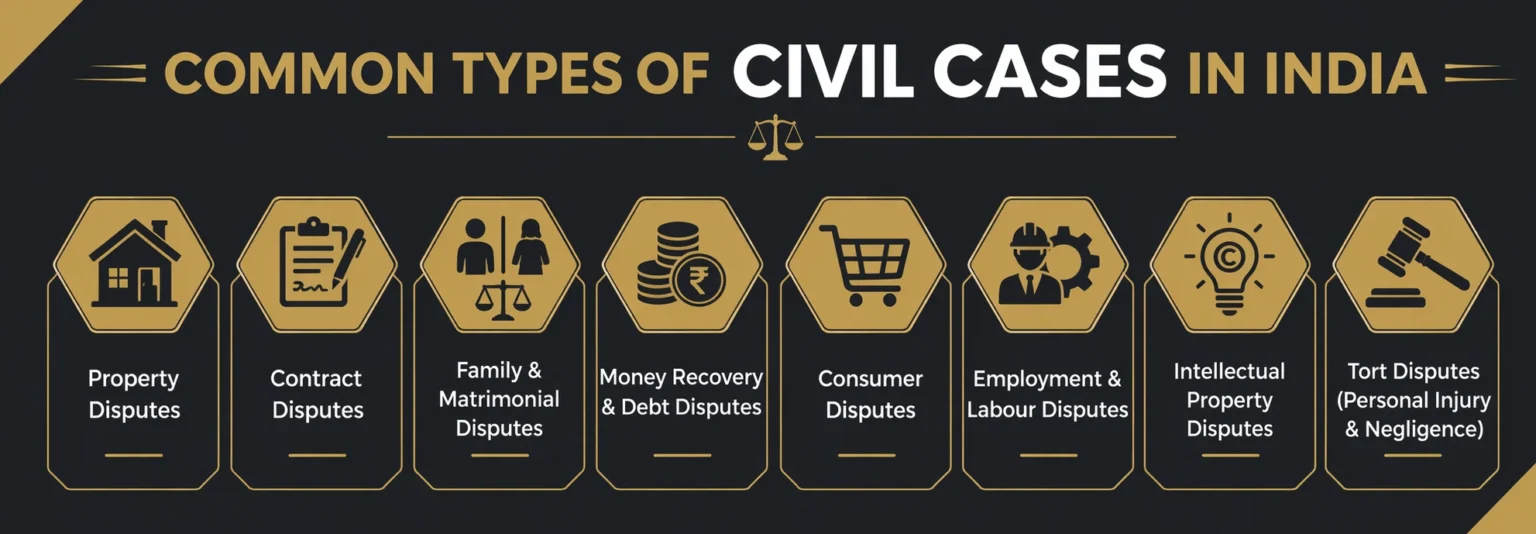
Civil law covers an enormous range of everyday disputes. Here are the main types of civil cases that Indian courts handle:
1. Property Disputes
One of the most common types of civil litigation in India. Property disputes involve disagreements over ownership, possession, boundaries, or inheritance of land, houses, or commercial property.
- Examples: Boundary disputes between neighbours, landlord-tenant conflicts, encroachment on land, illegal construction, co-owner disagreements, and ancestral property partition
- Governed by: Transfer of Property Act 1882, Hindu Succession Act, Specific Relief Act
- Srinivasa Law handles: Property title verification, partition suits, eviction proceedings, and possession restoration
2. Contract Disputes
When a written or verbal agreement is broken — or when one party fails to deliver what was promised — it becomes a contract dispute. This is one of the most frequent civil dispute examples in India for businesses and professionals.
- Examples: Unpaid invoices, breach of service agreement, vendor or supplier disputes, construction contract defaults, software or freelance work disputes
- Governed by: Indian Contract Act 1872, Specific Relief Act 1963
- Remedy: Specific performance (forcing the other party to fulfil the contract) or damages (compensation for the loss)
3. Family and Matrimonial Disputes
Family matters — divorce, maintenance, custody, and inheritance — fall under civil law in India. They are heard by Family Courts and governed by personal laws depending on religion.
- Examples: Divorce proceedings, child custody battles, spousal maintenance, dowry recovery, succession to property after a parent’s death
- Governed by: Hindu Marriage Act, Muslim Personal Law, Indian Succession Act, Guardians and Wards Act
- Why legal help matters: Family cases involve both legal rights and emotional stakes — a lawyer ensures your rights are protected throughout
4. Money Recovery and Debt Disputes
When someone owes you money and refuses to pay, you have a civil right to recover it through court. This applies to personal loans, business dues, and unpaid salary.
- Examples: Personal loan not repaid, salary not paid by employer, advance money not returned, rent arrears
- Legal routes: Civil suit for recovery, Summary Suit under Order 37 CPC for faster disposal, Debt Recovery Tribunal (DRT) for bank-related debt above Rs. 20 lakh
5. Consumer Disputes
India has a dedicated consumer protection framework that handles disputes between consumers and businesses, separately from the regular civil courts.
- Examples: Defective product, poor service, misleading advertising, overcharging, insurance claim rejection, delayed delivery
- Governed by: Consumer Protection Act 2019
- Forum: District Consumer Disputes Redressal Commission (for claims up to Rs. 50 lakh), State Commission, or National Commission
6. Employment and Labour Disputes
Workplace conflicts — between employees and employers — fall under a mix of civil and labour law in India.
- Examples: Wrongful termination, unpaid salary or gratuity, Provident Fund disputes, workplace harassment claims
- Forums: Labour Courts, Industrial Tribunals, High Court writ petitions in some cases
7. Intellectual Property Disputes
When someone uses your trademark, copyright, patent, or design without permission, you have a civil remedy.
- Examples: Trademark infringement, copyright violation, design copying, and domain name disputes
- Governed by: Trade Marks Act, Copyright Act, Patents Act, Designs Act
- Remedy: Injunction to stop the infringement + damages for losses caused
8. Tort Disputes (Personal Injury and Negligence)
When someone’s negligence or wrongful act causes you harm or loss — without necessarily involving a crime — you can sue for damages in a civil court.
- Examples: Medical negligence causing injury, road accident compensation (beyond insurance), defamation, nuisance caused by a neighbour
- Remedy: Compensation for physical injury, financial loss, mental distress, or reputational damage
Civil disputes in India have limitation periods — deadlines after which you cannot file a case. Most civil suits must be filed within 3 years of the dispute arising (Limitation Act 1963). Property suits related to possession have a 12-year limitation. Do not wait. Consult Srinivasa Law as soon as a dispute arises.
How Are Civil Disputes Resolved in India?
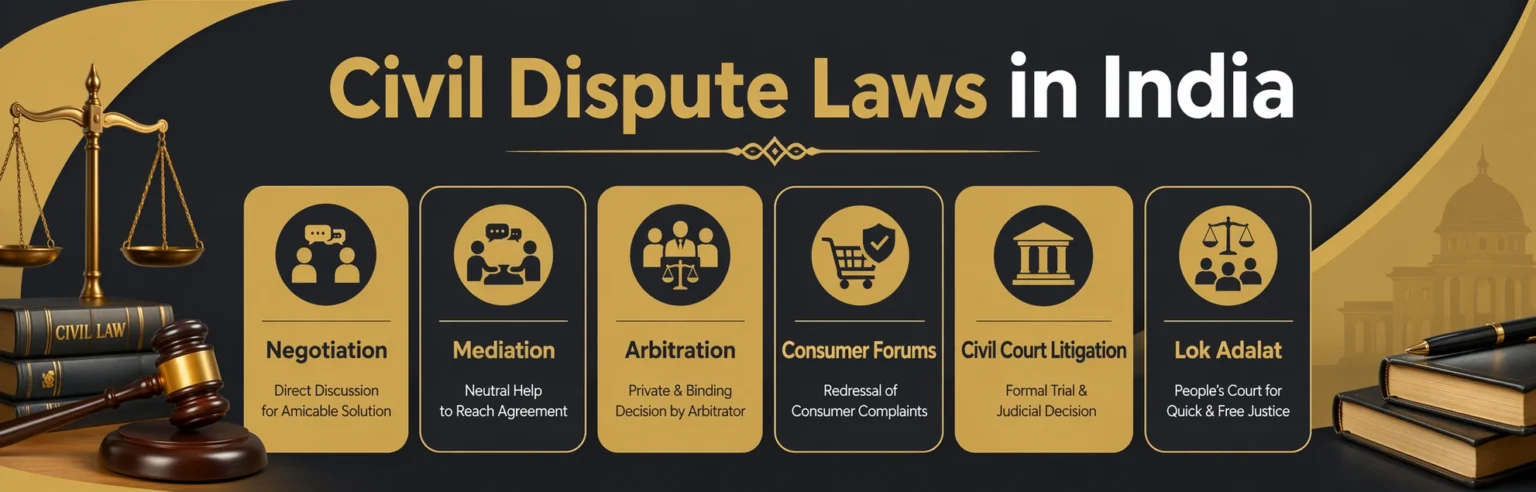
Not every civil dispute ends up in court. Here are the main pathways to resolution — from least to most formal:
- Negotiation: Direct discussion between the parties — the fastest and cheapest resolution. Most disputes that settle do so through negotiation, often with lawyer involvement
- Mediation: A neutral mediator facilitates discussion — a structured, confidential process where both parties work toward a mutually acceptable solution. Courts increasingly refer civil disputes to mediation before proceeding to trial
- Arbitration: An appointed arbitrator hears both sides and delivers a binding award. Common in commercial contracts that include an arbitration clause. Faster than court litigation
- Consumer Forums: For consumer disputes — a dedicated, cheaper, and faster system than regular civil courts
- Civil Court litigation: Filing a plaint in the appropriate civil court — District Court for most matters, High Court for complex or high-value cases, and the Supreme Court for the highest level of appeal. Governed by the Code of Civil Procedure (CPC) 1908
- Lok Adalat: A pre-litigation or in-litigation settlement forum — cases decided here are final and binding, with no court fees refunded or charged. Excellent for motor accident claims and family matters
When Should You Hire a Civil Lawyer?
Not every situation requires you to hire civil lawyer services immediately. But a lawyer should be your first call in any of these situations:
- Your rights to property, money, or a contract are at stake — and the other party is not cooperating
- You have received a legal notice — any notice from a lawyer, court, or government body requires an urgent legal response
- The dispute involves a significant amount of money or business loss — or you need to file a commercial dispute case — professional legal guidance protects your position and your evidence
- The other party has already filed a case against you — you need to respond correctly and within the court’s deadlines
- The limitation period is approaching — delays in filing can permanently bar your right to sue
- Documents or agreements are in dispute — a lawyer evaluates what is enforceable and what is not
- Family or inheritance matters — where emotions run high and legal rights are complex and intertwined
What to Do If You Are Involved in a Civil Dispute — Tips from Srinivasa Law
1: Do Not Delete Any Evidence — Digital or Physical
Screenshot and back up all digital communications immediately when a dispute arises. Gather physical documents — agreements, receipts, invoices — and keep certified copies in a safe location separate from the originals.
2: Respond to Legal Notices Within the Required Time
If you receive a legal notice, you must respond — ideally within the period stated in the notice (usually 15–30 days).
3: Do Not Sign Anything Without Legal Review
Signing without legal review can waive rights you did not even know you had — and make it significantly harder to pursue your full claim later.
4: Understand that most cases settle with a plan for That Outcome
The majority of civil cases in India are resolved through negotiation, mediation, or out-of-court settlement before or during trial.
Conclusion
Civil disputes are a part of life — property conflicts, broken contracts, unpaid money, and family disagreements. They are not rare or exceptional. They happen to ordinary people every day across India.
What makes the difference between a dispute that is resolved fairly and one that drags on for years is usually how quickly you get the right legal guidance.
Understanding what a civil dispute is, what type it falls under, and what your legal options are is the foundation. Acting on that understanding early, with the right legal team, is the strategy.
Srinivasa Law handles civil disputes across property, contracts, family, consumer, employment, and intellectual property — with a focus on efficient resolution, clear client communication, and protecting your rights at every stage.

Advocate Vijay Kumar is the Founder and Principal Counsel of Srinivas Law House. With LLB and LLM qualifications, he is known for strategic litigation, strong courtroom advocacy, and delivering focused, transparent legal representation across diverse legal matters.